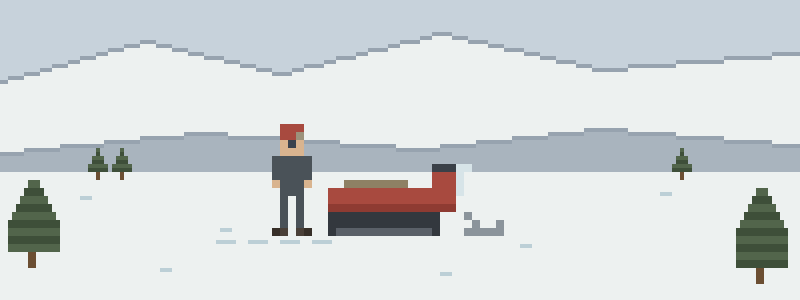
Speed, cold, and distance — pick three
- The tree line at speed. He centered a spruce at fifty and now he’s in the powder, helmet on, not answering right. High-energy mechanism means you run the whole system — spine included.
- Overflow. The creek was under the snow and now she’s soaked to the waist, ten degrees out, twenty miles in. The clock started when the water touched her — the wrap is the answer.
- The ride out. A splinted arm, a two-up seat, and an hour of wind chill to the truck. An injured passenger cools faster than a riding one — insulation, pace, and knowing what worsening looks like are the whole decision.
Pre-season reading order
Ordered for how sled days go wrong:
- Patient Assessment — high-energy crashes demand the full system, even with numb fingers
- Spine & Helmets — trees don’t give — mechanism respect and the helmet call
- Cold Injuries — immersion, hypothermia, frostbite — this sport’s home turf
- Musculoskeletal Injuries — splint before moving — especially before a bouncing ride out
- Evacuation — carry, ride, or call — spending people wisely at ten below

Then pressure-test it
Interactive scenarios — one decision at a time, tempting mistakes included, debrief at the end:
- The Rider Down — a downed rider, cold closing in, and the evac call
- The Burrito — the immersion wrap, done in order
- Leave It Frozen — the frostbite call sledders actually face
The certification question, honestly. “Wilderness First Aid” isn’t a regulated credential. No government body defines what a WFA card means — it means whatever the company that printed it says it means. What counts in front of a patient is whether you can do the work. This course teaches the work, free, and issues a record of completion — not a certificate, and we won’t pretend otherwise. The real credential in this sport is avalanche training — an AIARE or equivalent rescue course plus honest beacon practice — and nothing here touches it. If a guide operation or employer wants a provider’s first aid card, take their class; this keeps you sharp between. If nobody requires you to hold a card, what you need are the skills, not the laminate.
What this is
Fifteen lessons, a 40-question knowledge check, sixteen practice scenarios, a printable field reference card, and a kit checklist. Free, no account, nothing recorded about you, source on GitHub. It teaches decision-making, not hands-on skill — practice the hands-on parts on a real, padded, complaining friend.
Other throttle-and-altitude people: paragliders, hang gliders & PPG pilots · remote drone operators & aerial surveyors · dual-sport & ADV riders